
How to collect cat faeces for in-clinic qPCR
Collecting a good faecal sample is the first step to getting a reliable qPCR result for gastrointestinal pathogens. Here’s a simple, cat-friendly guide you can use in the clinic.
What you need?
- Sterile faecal swab with transport tube
- Gloves
- Label (patient name, date, time)
- Fridge at 4 °C
- Freezer at –20 °C (for longer storage)
Step-by-step: taking the sample from cats
Step 1 – Prepare the tube
- Put on gloves.
- Write cat’s name, date and time on the tube before sampling.
Step 2 – Collect fresh faeces
You can do either of these:
- From litter tray:
- Choose a fresh stool (ideally < 1 hour old).
- Gently move the top of the stool to avoid touching litter.
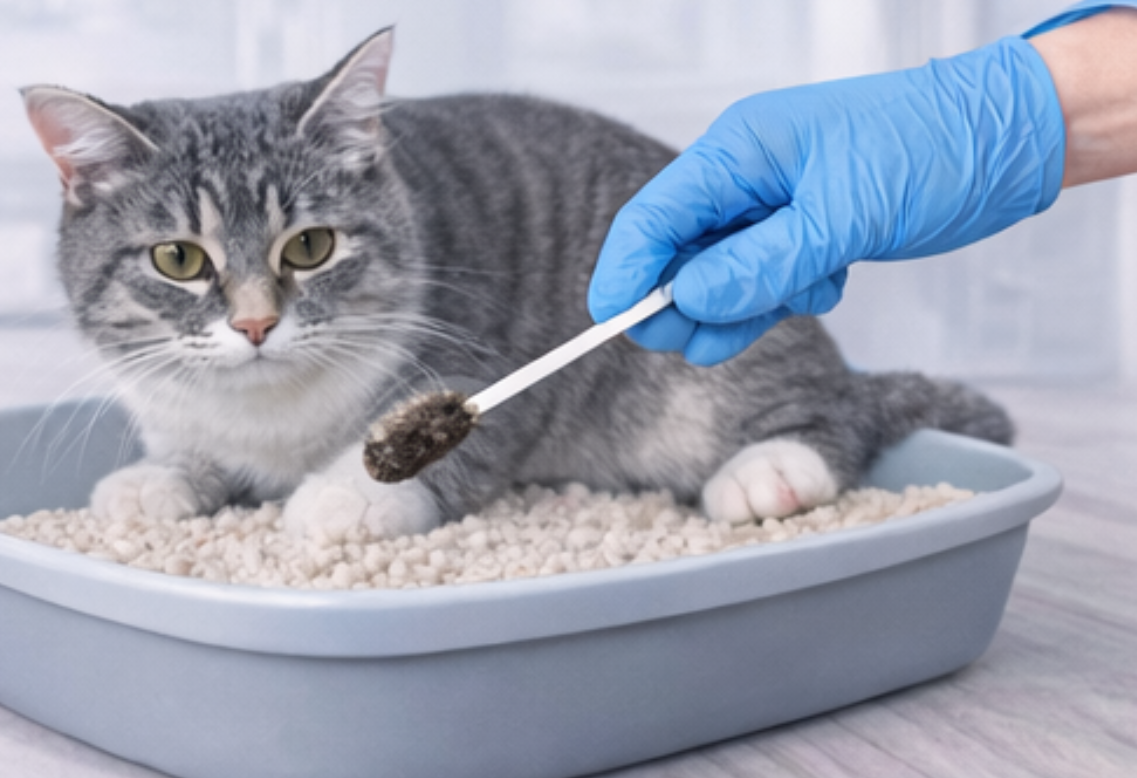
- Using the swab, roll it over the surface of the stool so it’s lightly coated.
- From rectum (if needed, by clinical staff only):
- Lubricate the swab.
- Gently insert just the tip into the rectum.
- Rotate once or twice, then withdraw.
Step 3 – Put the swab in the tube
- Place the swab back into the tube.
- Break off the stick at the mark if needed and close the cap firmly.
How to store the sample (to protect DNA and RNA)
To keep the genetic material stable for qPCR:
- Short term (up to 24 hours):
- Store the tube at 4 °C (normal fridge temperature).
- Keep it upright and away from food.
- Longer term (more than 24 hours):
- Store the sample at –20 °C.
- Avoid repeated freeze–thaw cycles: freeze once, thaw once for testing.
Sampling note: parasites vs. bacterial/viral pathogens (timing and number of samples)
When interpreting faecal diagnostics, it is important to recognise that optimal sampling strategies differ for parasites compared with bacteria or viruses.
Intestinal parasites (helminths, protozoa)
Many parasites are shed intermittently, and oocyst/egg output can fluctuate from day to day. For routine parasitological screening or when parasitic disease is suspected, it is generally recommended to:
- Collect at least 3 separate faecal samples from the same animal over 3–5 consecutive days.
- Pooling small aliquots from each day into a single submission can improve sensitivity for flotation/centrifugation, Giardia, coccidia, and some lungworms.
- In high-suspicion cases with an initial negative result (e.g., suspected Giardia, whipworms), repeating a second 3-day series several weeks later further increases diagnostic yield.
Bacterial pathogens (e.g., Salmonella or Campylobacter)
In contrast, enteric bacteria associated with acute diarrhoea are often shed at high concentrations early in the course of disease:
- For most clinical purposes, one fresh sample collected at the onset of clinical signs (or within the first 24–72 hours of diarrhoea) is sufficient for culture and/or qPCR.
- If clinical suspicion remains high and the initial result is negative, a second single-sample test 24–48 hours later may be considered, but routine multi-day sampling is usually not required outside research or surveillance studies.
- For carriage/shedding studies (e.g., Salmonella or MDR E. coli in raw-fed dogs), protocols often use 1–3 samples per animal, collected over 1–2 weeks, to better capture intermittent shedding, but this is a research rather than a clinical standard.
Viral pathogens (e.g., parvovirus)
Enteric viruses typically show a relatively narrow high-shedding window:
- The ideal sample is collected as early as possible after the onset of diarrhoea, preferably within the first 3–5 days of illness.
- In most clinical settings, a single sample is adequate for PCR.
- Repeating the test after 24–48 hours may be helpful if the first sample was taken very early (pre-shedding) or if clinical suspicion is high despite an initial negative result.