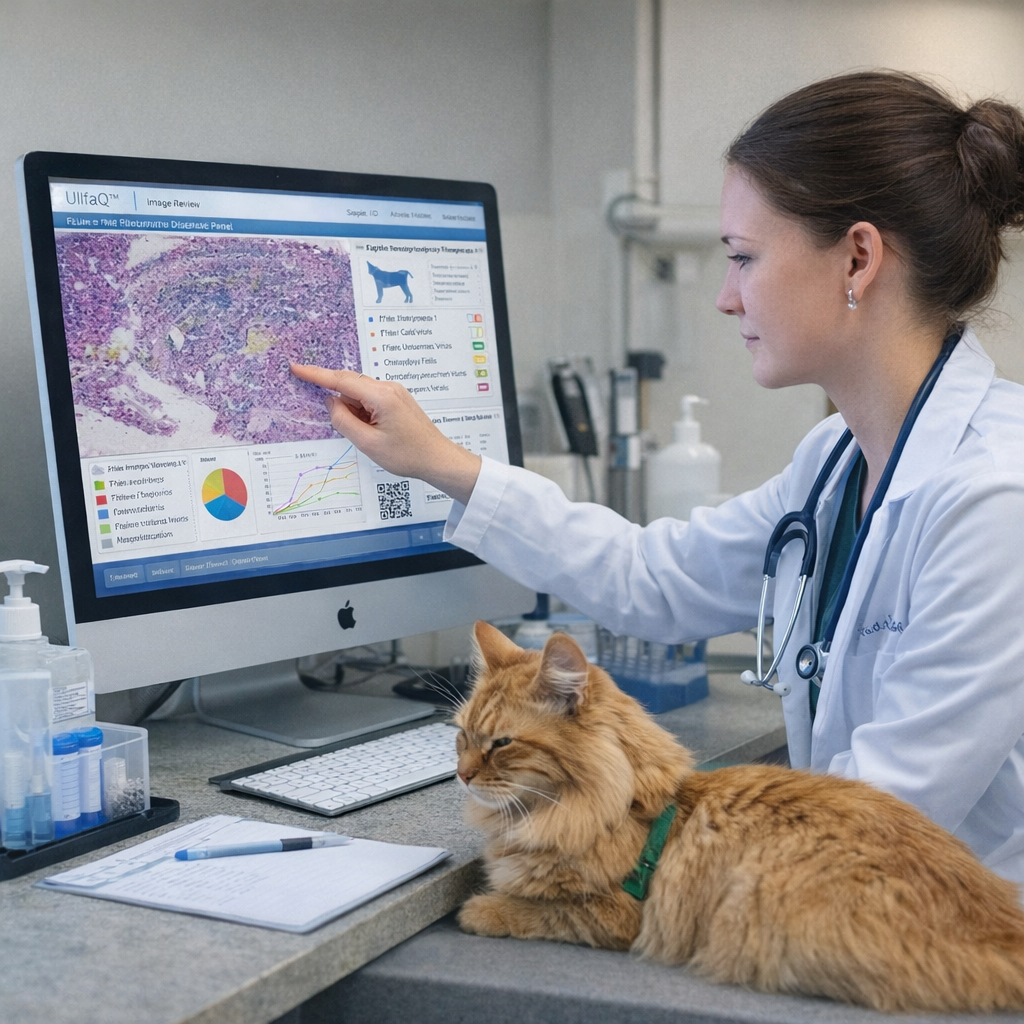

AI is rapidly moving from experimental tool to an everyday assistant in veterinary diagnostics, especially in imaging and pathology, and AniPath from Zytca Animal Health is an example of how these advances are being translated into practical tissue biopsy diagnostics for companion animals. Recent publications show deep learning models now match or approach specialist-level performance on tasks such as tumour classification, radiology, and herd health prediction, setting the stage for clinically integrated platforms like AniPath.
How AI is reshaping vet diagnostics
Recent reviews highlight a surge in deep learning applications across veterinary radiology, pathology, and on‑farm monitoring, with many models achieving accuracies above 90% for specific diagnostic tasks such as canine skin tumour classification and cardiac disease detection. These systems typically use convolutional neural networks or transformer-based vision models to read whole-slide images, X‑rays, or MRI scans, turning pixels into quantitative metrics that support faster and more consistent decision-making in practice.
In veterinary pathology, AI is increasingly used for image analysis, pattern recognition, and predictive modelling, helping pathologists detect tumours, quantify lesions, and correlate microscopic features with prognosis. By automating repetitive measurements and screening, AI allows specialists to focus on complex cases and nuanced interpretation rather than manual counting or low-yield negative slides.
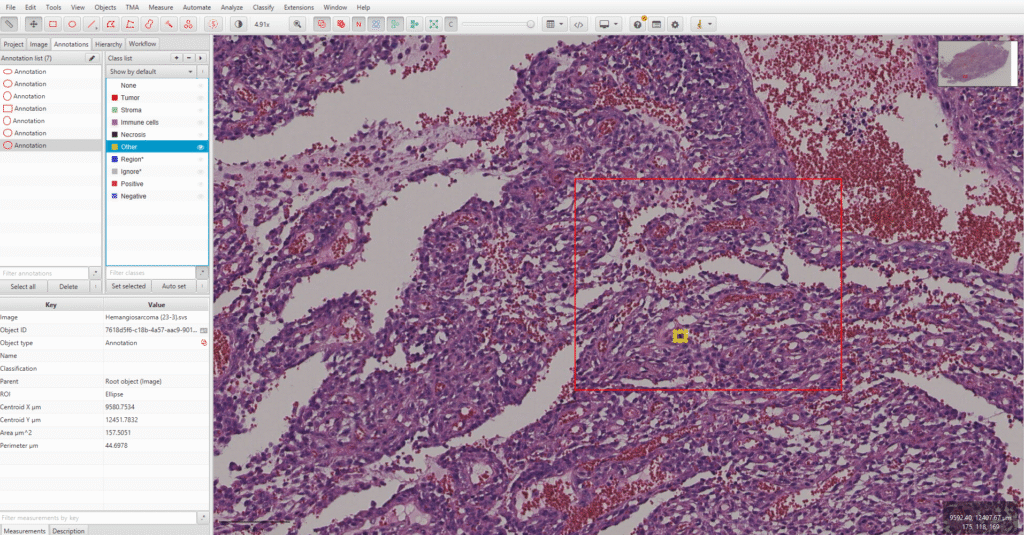
Example of AI development from (digital whole slide image; WSI) histopathology image. Regions of interest (red square) highlight mitotic activity (yellow circle) in a confirmed canine haemangiosarcoma.
Evidence from recent publications
A 2025 review in Frontiers in Veterinary Science describes applications of deep learning in veterinary diagnostics ranging from automated detection of canine skin tumours on haematoxylin and eosin whole-slide images (reporting accuracy around 0.95) to CNN-based tools (convolutional neural networks) for canine cardiomegaly and stifle joint disease. Transfer learning and hybrid architectures (for example, region-based CNNs combined with ResNet backbones) are enabling robust models even from relatively small veterinary datasets, which has historically been a major barrier for this field.
Beyond pathology, machine learning has been successfully used to assist diagnosis of dairy cow diseases from clinical and sensor data, where models using transfer learning achieved higher F1 scores than traditional methods. These studies collectively suggest that AI can improve both speed and standardisation of diagnosis while opening new possibilities in prognostic modelling and herd-level decision support.
Where AniPath fits in
AniPath, developed by Zytca Animal Health, is positioned as an AI‑assisted pathology solution specifically for pet cancer diagnosis, providing an end‑to‑end workflow from sample to clinical decision. The platform’s models are trained on more than 20,000 real clinical cases and whole-slide images using weakly supervised learning, enabling instant slide analysis and quantitative metrics that help veterinary pathologists standardise and support their diagnoses.
By structuring tissue and cell data and embedding AI directly into the reporting process, AniPath aims to make diagnosis both easier and more robust, allowing pathologists to devote more time to case interpretation while still benefiting from consistent image-level quantification. The service is designed to integrate flexibly into existing systems, so clinics and laboratories can adopt AI support incrementally while maintaining established workflows and quality controls.
Together, these developments show how AI is evolving from research prototypes into clinically embedded tools that extend veterinary expertise, with platforms like AniPath illustrating how high‑quality training data, workflow integration, and explainable quantitative outputs are likely to define the next generation of veterinary diagnostics.
REFERENCES:
Xiao S, Dhand NK, Wang Z, Hu K, Thomson PC, House JK, Khatkar MS. Review of applications of deep learning in veterinary diagnostics and animal health. Front Vet Sci. 2025 Mar 12;12:1511522. doi: 10.3389/fvets.2025.1511522. PMID: 40144529; PMCID: PMC11938132.