


💡Routine qPCR faecal testing can help identify which cats genuinely carry intestinal worms, allowing more targeted worming protocols, reducing unnecessary anthelmintic exposure and supporting antimicrobial resistance (AMR) stewardship in small animal practice.
💡ESCCAP is the European Scientific Counsel Companion Animal Parasites
From “monthly worming” to “test-and-treat”
The December 2025 Vet Times by Boehringer Ingelheim article highlights that 68% of UK cats fall into the highest ESCCAP risk group based on lifestyle, for which monthly worming or regular testing is recommended. ESCCAP also explicitly recognises faecal examinations as an alternative to repeated routine treatments, with anthelmintics given when infections are documented. Integrating qPCR into that framework allows clinicians to move from a default “treat every high‑risk cat monthly” model towards an evidence‑based “test‑and‑treat” strategy. This approach is particularly valuable in cats with intermittent hunting, variable outdoor access or multi‑cat households where parasite pressure can change over time.
Why qPCR improves intestinal worm detection
Traditional faecal flotation and microscopy can miss low‑burden or intermittent shedders, and require good-quality, fresh samples and significant operator expertise. Comparative studies in small animals show that broad qPCR panels detect a significantly higher overall frequency of gastrointestinal parasites and more co‑infections than centrifugal flotation, while maintaining substantial agreement with conventional methods. qPCR can also be designed to detect specific parasite species and even genetic markers associated with benzimidazole resistance in hookworms, providing additional clinical insight. For feline practice, this means improved detection of roundworms and hookworms in cats that may appear clinically well but still pose zoonotic risk, particularly in households with children or immunocompromised people.
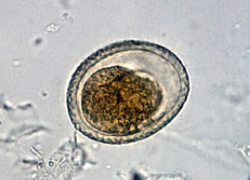
Unembryonated egg of Toxocara cati (65–75 µm × 60–70 µm) recovered from feline faeces. The thick, brown, proteinaceous shell has a finely pitted surface.
Reducing over‑treating and supporting AMR stewardship
ESCCAP emphasises that regular coprological examinations with treatment of positives is a legitimate alternative where routine frequent worming is not acceptable or desired. By deploying qPCR at defined intervals (for example, 2–4 times per year in higher‑risk cats), clinicians can reserve anthelmintic treatment for cats with documented infections, reducing cumulative drug exposure over the cat’s lifetime. Lowering unnecessary anthelmintic use reduces selection pressure for resistance in intestinal nematodes, which ESCCAP has already identified as a concern and an area where more sensitive molecular tools are needed. This aligns well with wider veterinary AMR principles, where targeted therapy based on diagnostics is preferred over blanket prophylaxis with parasiticides or antimicrobials.
Practical integration with existing parasite plans
Risk‑assessment tools such as Parassess already help veterinarians stratify cats into different ESCCAP risk categories and open up conversations with owners about lifestyle factors and zoonotic risk. Adding qPCR faecal testing into those workflows gives an objective parasitological “anchor” for discussions about whether a given cat needs monthly, quarterly or purely seasonal worming. For example, a high‑risk hunting cat with repeated negative qPCR results over time may justify a longer dosing interval than one with recurrent positive tests, even if both share similar lifestyles. Conversely, qPCR‑confirmed infections in apparently low‑risk indoor cats can strengthen recommendations for ongoing preventive treatment and environmental hygiene.
Further details of ESCCAP can be found at Parasites | ESCCAP
Positioning qPCR alongside spot‑on parasiticides
The Vet Times article describes how products such as the monthly spot‑on NexGard COMBO provide broad‑spectrum protection against key feline parasites, including fleas, ticks, roundworms and tapeworms. qPCR does not replace such parasiticides, but helps ensure they are used in the right cats, at the right frequency, for the right reasons. In cats with persistent positive qPCR results or evidence of heavy environmental exposure, a monthly product with tapeworm and roundworm coverage remains a rational choice. In contrast, cats with consistently negative qPCR tests and limited exposure may be candidates for extended intervals or seasonal use, supporting practice‑level goals around responsible parasiticide prescribing and AMR-conscious medicine.
For more information, please visit the website UlfaQ™ In-clinic Real-time PCR – ZYTCA | Advanced Veterinary PCR Diagnostics for Animal Health or contact us directly.